

Report about my stay at Ngora Freda Carr Hospital, 11-22/09/2023
I travelled from Spain to Uganda via Amsterdam, expecting to arrive the 9th and join there Teresa and Jane to travel the 10th to Ngora. It was not possible as I missed my flight from Amsterdam to Entebbe (plane left Madrid three hours late). Thus, I had to fly on the 10th and we were picked up the 11th by the vehicle&driver of Ugandan Protestant Medical Bureau. Stella Akurut joined us near Kampala, and we travelled together to Ngora. She bought us dinner at the best hotel in Ngora, and later took us to the hospital´s guest house. Road was beautifully tarmacked until about 50kms from Ngora, where it becomes murram, with the usual potholes and dust.
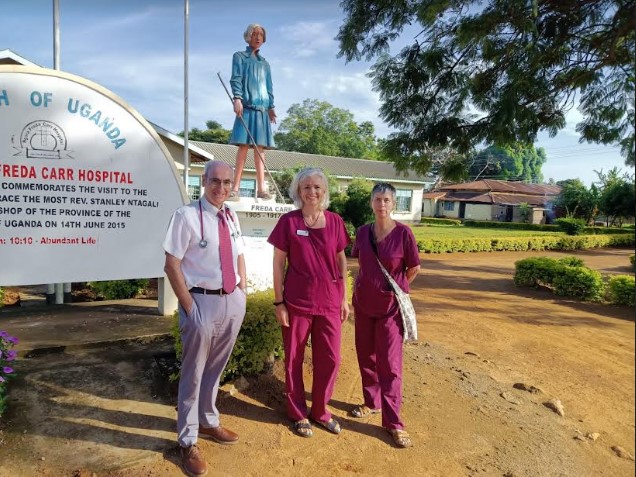
This is a nice house outside the hospital compound, with three spacious bedrooms, leaving room, dining room, toilet and bathroom with shower which has cold and hot water –as long as there is electric supply. Kitchen was well furbished and there was a bottle of gas in case the power supply was out, which happened frequently during our stay, due to storms. On the other hand, water supply never failed. The power supply company has the policy of switching off the supply for the whole area as soon as thunders start, and being in the rainy season, they did it on almost a daily basis. It seems they want to avoid more severe problems.
The house was clean, with cutlery which seemed quite new. Teresa and Jane had bought in Entebbe food to cook our meals and you could also buy some things in Ngora market and a small supermarket there –quite limited options though but more than enough- and travelled once to Kumi, where there is also a market and some supermarkets. I intended to change some dollars but no bank accepted unless I had an account. I could get Ugandan money from the ATM in those banks though. I had previously agreed with Stella that I´d pay for the petrol of the vehicle (the ambulance of the hospital) that took us to Kumi. I gave the driver the amount to pay for the fuel that he needed, it was little. To go to Ngora, which I did a few times, it is possible to walk (around 45 minutes) or catch a boda-boda (they asked 3000UGX for a return trip, which is three times what they charge people but it being less than one dollar, I was not going to argue or haggle).
Life at the house was comfortable, mattresses were new and bedclothes were changed at least twice during our stay. A lady from the hospital came everyday for the cleaning and also washed our clothes, she did not ask for any fee (if we gave her some money was our decision). We had a key and she got in through the kitchen´s door.
The only problem with the house was that, being outside the hospital compound, children and especially youngsters devoted their leisure time to upset us, asking for things and being somewhat intimidating and even uncouth, to the point of throwing hard objects to the window and door. We reported to Ms Akurut and one of the hospital´s watchmen started to drop by the guest house in the late afternoon/early evening, and we did not have any more problems after that.
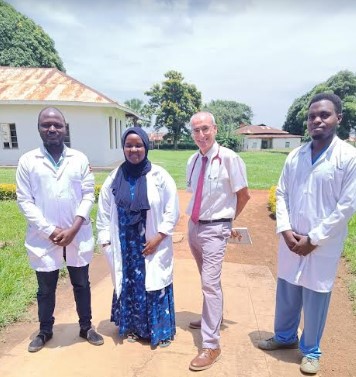
Regarding my medical tasks, I was introduced to the medical officer, Dr. Peter Lubega, and to the two interns who were at the medical ward during my stay, Dr. Anuna Alli and Dr. David Okiror (in fact they are not doctors, but are called so anyway, in their last year of medical studies they are assigned to a general hospital, in three-month stints at medical, surgical, pediatric and obs&gynae ward, I think is the first time in last years that the hospital holds this program; she came from a private university and he from one of the public universities).
Dr. Lubega has trained at Mbarara University and did his internship at Lacor hospital, perhaps the best in Uganda, which has external support (I think from Italian foreign cooperation). He is very capable and seems to have an interest in internal medicine. Very good, with plenty of common sense and good previous training, within the diagnostic and therapeutic limits of Uganda. He was also quite devoted to his task during my stay, reasonably punctual and showing much interest to learn. The two interns were not too good but at least he showed interest to learn and asked sound questions. She was not so interested but I´ve seen much worse in previous visits to Kitovu. The fact that nowadays Uganda has around nine universities where you can get a medical degree, -in sharp contrast with my first time, where just Makerere existed, and then Mbarara-, positive as it may seem, may be actually the opposite: interns seem to be much less exposed to clinical training during their studies, and that has a clear influence in their attitude and skills. That said, for the hospital is interesting to hold internship programs and I understand they intended to start clinical sessions (continuing medical education). When and how, I do not know.
I also ran into other interns and medical officers during my days there, mainly through visits to patients in other wards because of medical reasons. My impression is that the interns I ran into were motivated and capable.
I did not have the chance of talking long with the acting medical director, whose name to be honest I do not remember, he is a surgeon, but seemed to be a fine fellow. Never met the former two medical directors (Dr. Odiit and Dr Cherop, who had just resigned as director). They seem to be mainly interested in teaching at the nearest medical school, placed in Soroti.
I was told that there are to external physicians, never met one of them but did once with Dr. Apollo Epuwatt, who has a private practice in Tororo, some two hours´ drive from Ngora. He has scheduled the ward round on Wednesdays, even though I guess he joins at around mid-morning, and told me that is a member of the board of governors of the hospital. He is near retirement age, was polite and has a somewhat classical approach to training younger clinicians, in general giving them “a bad time” during the ward round. Just an impression though.
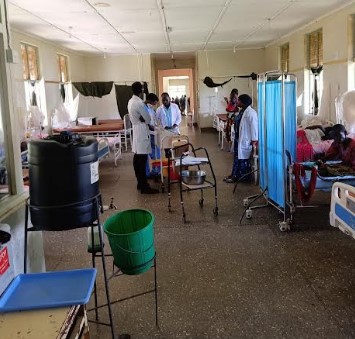
We visited 10-15 patients every day, in general with severe medical conditions, probably because, as the hospital has to charge fees to sustain itself, they just go when they are seriously ill. Some cases of complicated and severe malaria in young people, and in general, diseases which are common in any medical ward, just more advanced (wasting syndromes, stroke, heart failure, meningitis).
It´s worthwhile to explain here what is, in my opinion, the main problem in Ngora (also in Kitovu), ie nursing care and nursing dynamics in general. I reckon the risk of being drastic, but unless nurses´ approach to health care at Ngora transforms itself, there is no much hope of any improvement from a clinical point of view. Because one thing is to practice medicine without many means (you just have basic laboratory values such as complete blood count, some biochemistry –if the machine works at all, which did not do during my stay, you could not determine basic renal parameters or ions-, malaria parasites in blood, stool analysis, some basic stains of biological fluids, HIV test –but not CD4 or viral load-), and another is being unable to rely on basic tools of our work such as knowing the vitals of a given patient (BP, heart rate, respiratory rate, temperature, S02 if possible) or if the drug prescribed has been given at all. These tools are good and free all over the world.
In general, nurses did not register vitals or they are unreliable. They do not know how a patient is doing and if medications have been given. The doctor prescribes a drug which may be lifesaving in the short term, and then nurses have to introduce the prescription in the computer and only afterwards the relatives –if they are there at all- will go to the pharmacy, pay for the drug and deliver it to the same/another nurse, should the drug going to be given through the parenteral route. Then the nurse will give the drug, or not, and will sign, or not. If the drug is taken per mouth, the relatives are responsible.
The whole system is unreliable and you find yourself next morning counting the pills to guess if the patient has had any of those, or not. Sometimes there is no any improvement, just because drugs have not been given: relatives unable to afford them, or never given by nurses. And nobody knows/wants to know the reason. There is always somebody else to put the blame on (the night shift nurse, who is not there anymore, the relative who had been there before). In an environment where you do not have tests really available, you have to rely on clinical skills and vitals to know how the patient is doing. But it is impossible to know if the patient has passed any urine, or the amount, or BP, or heart rate …
Situation was rather similar in Kitovu once Dr. Lynch disappeared. It is difficult to know what nurses are trained to do, or their responsibilities, if any. I´m sure this happens all over Uganda, and more so in public health facilities, but NFCH is the place that I visited and that Rotary Doctor Bank UK is currently supporting. Unless nursing care improves there, I cannot see any fruitful clinical collaboration aside from building new wards or supplying devices to improve specific departments such as radiology. Because if people do not get better treatment than at the public facilities and they have to pay for it, which is the point of being admitted to NFCH? I know I may sound somewhat defeatist, or blunt, but I have been sufficient times to Uganda to know when a ward works and when it does not. And the medical ward at NFCH does not work, and the MO that I met there is not to blame, nurses and nursing system is.
You could request radiological plain films and ultrasound scan. Films where useful as long as the patient was thin, otherwise they could be non-diagnostic, and moreover expensive at 30.000UGX. US scans where there, but I´m not sure if very reliable (the technician suggested diagnosis that used to fit the clinician´s description of the case). In some cases though (for instance in the study of liver masses), it was worthwhile to perform it. I understand that Teresa&Jane work at the radiological department will surely have much improved the quality of the films. I know they met highly motivated radiographers, which were very nice to me too.
Was my stay at NFCH ward useful at all? I do not know. I tried to share some clinical reasoning with the medical staff, as they need a strong clinical acumen to be able to diagnose uncommon conditions there, or common conditions that present with atypical traits. They do not have diagnostic means that we take for granted, in fact they did not even have an EKG machine, which should be a good tool to supply (as long as it is not as expensive as the X-ray processor) to ship to Uganda. I may ask at my hospital if there is any device that could be available for donation.
In my experience, for a medical ward to work, you need a permanent time physician (in general a MO, however skillful or capable he may be, is not enough, as they tend to keep moving within the hospital or going somewhere else), which may be difficult to find given the economic problems of the hospital. And even more a motivated medical director. If NFCH is going to find any of those, I do not know, but now it is a good moment as they have started to train interns.
After the ward round, that ended at around midday/early afternoon, I went to our house for lunch, and afterwards I was free for a walk, going to Ngora, reading at home … the usual, somehow lonely life of a volunteer at any African hospital; in that regard, going with Teresa and Jane was very positive, as we could share our meals and talk about the ups and downs of our tasks and the hospital in general. Hope they were also happy of having me around, I think we got on well. I told the interns and MO that they could call me if needed any help out of office hours, they just came once, but I used to drop by the ward at around 5-6pm, and a few times I reviewed some difficult admission with them.
The area is flattish and beautiful, plenty of small roads and paths to explore, as long as you are not afraid of domestic animals –some of them rather big such as the ankole cattle bred in the area- and happy to greet the many people that you find during your walk, especially children, that keep calling you mzungu and waiting for a reply. Never run into an unfriendly person during my daily walks.
To end with, it is remarkable how well our transport worked: for first time in all my visits to Africa, the driver picked us up at the exact time, and took us back safe to Entebbe. The night before some members of the hospital staff took us for dinner to the best hotel in Ngora, and gave us beautiful presents (dresses to Teresa and Jane, a shirt for me). There were short discourses and I think they really appreciated our stay with them. I´m sure they have high expectations about the support that they may get from us.
I do hope that this long report may be of interest to you. I´ve tried to describe my impressions and some feelings after my short stay at NFCH, which RDB did possible for me, and for which I´m deeply grateful.
Ángel García Forcada
Zaragoza, Spain
10/10/2023
 THE ROTARY DOCTOR BANK of GREAT BRITAIN and IRELAND.