

Report by Jane Cheveau and Teresa Dawkes.
Myself, Teresa and Angel arrived in Ngora Mon 10th Sept, a day later than originally planned and after a lovely meal with Stella at the Galaxy Country Club we were dropped off at the guesthouse to unpack and prepare for work the next day.
Stella collected us from the guest house Tues at 8am and gave us a tour of the hospital ending at the x-ray dept where we met Christopher, the x-ray assistant. He immediately welcomed us and proceeded to show us the department and all their paperwork. We were immediately impressed with the record keeping, all the patient details were logged with examination types and even included a film tally so they wouldn’t suddenly run out of film. Interestingly the new computer system in the Ultrasound dept had been developed by Kisiizi Hospital which was the first project we were both involved with!
Christopher was very helpful, and we were again pleasantly surprised as he showed us all the Atomic Agency reports with the recommendations and the Radiation survey reports. There was a Licence to possess and use radiation generating equipment, in date and on display.
We went into the darkroom which is of a ‘light trap’ style meaning there are a few turns on the way in which is very effective but it was very small with no extraction fan, there was a very strong smell of chemicals and we did worry the processor wouldn’t actually fit through!
We then met Joseph (Radiographer) who also made us very welcome. They had a lovely easy relationship between them, having known each other for a long time which was key to us being able to achieve all that we did.
The Team
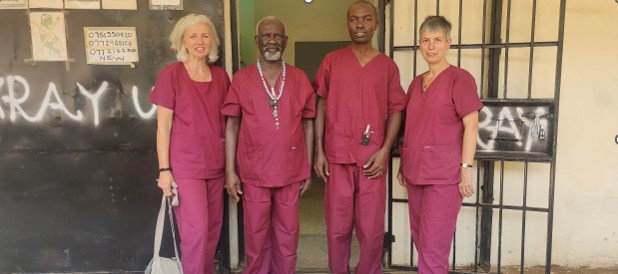
We had decided to observe for the first couple of days to see if we could identify what we could help with and concentrate our efforts on.
We had already noted that the exposure factors were very high.
We decided on:
- X-ray dose reduction
- Improve image quality
- Radiation protection
X-ray dose reduction
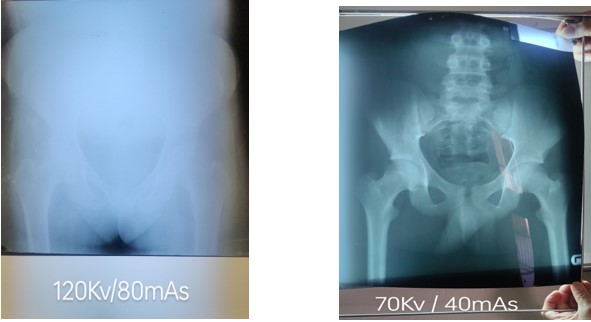
We noted fairly quickly that the exposure factors were very high. This was primarily due to having very old cassettes with a blue film/screen combination and out of date chemistry. We had taken a good selection of green cassettes and Stella kindly ordered the necessary green films.
This subsequently resulted in over 50% reduction in x-ray exposures.
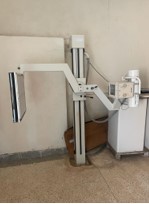
The x-ray equipment in use has a fixed distance of 150cms but most examinations should be done at 100cms so we worked on ways to achieve this which also reduced the doses.
Phillips X-ray equipment
Improve image quality
We noted some of the x-ray images were of poor diagnostic quality due to a number of factors: very old damaged cassettes, scratches from metal film holders and the inability to image Abdomen, pelvis or lumbar spine images on even the slightly larger patients.
Original quality Much improved image using less than half the dose!
We had freighted out an Automatic X-ray film processor in advance but due to problems in customs it didn’t arrive at the hospital until Tues of our second week. This piece of equipment standardises image processing, cuts down on the film handling so less scratches or finger marks, much quicker than wet developing (film comes out dry) and reduces the staff exposure to the toxic chemicals. (Wet developing has open containers of chemicals to dip the film into)
We had limited time now and had quite a few problems setting the processor up but we (again) had huge support from Graham Haslam of Wolverson Xray Ltd. We sent him videos and WhatsApp messages and he advised us how to proceed. So, finally on Thursday afternoon it was in action. Both Christopher and Joseph were helping us at this point so they now have quite a good knowledge of how it works and we are confident they will be able to troubleshoot any problems effectively.
Initially we tried to set up the processor in the darkroom but that became very problematic and an unhealthy environment for us to be working in. ( The extractor fan was broken)
We discovered that the x-ray room was completely light tight and we’d taken out a portable safelight which was perfect so the carpenter who built the table in the darkroom came and re-assembled it in the x-ray room.
The combination of new faster cassettes and the automatic processing of images has resulted in highly improved diagnostic images.

Also, we took out plenty of right and left side markers and a R L side stamper so films are now marked up correctly.
Radiation Protection
There were plenty of lead protection items and we encouraged them to use them ie. Patients relatives required to hold patients in position should wear a lead apron. We took gonad shields, a lead apron and thyroid shield with us much to the consternation of the security staff at both airports!
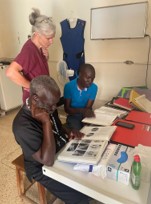
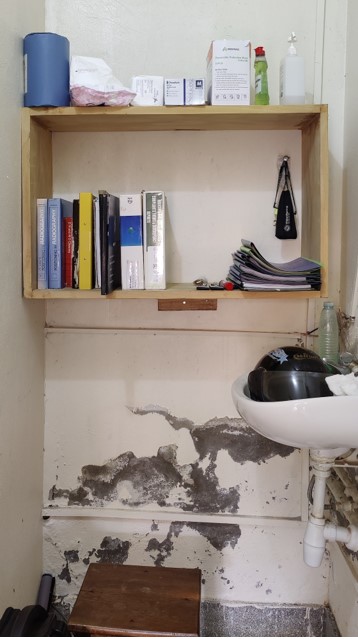
We also took out lots of reference books and suggested a shelf to put them on would be a good idea. This was immediately organised by Christopher, when the electric was back on for the cutting/sanding equipment!
Not all the books are in this picture as we were running out of room to put them until this shelf was made.
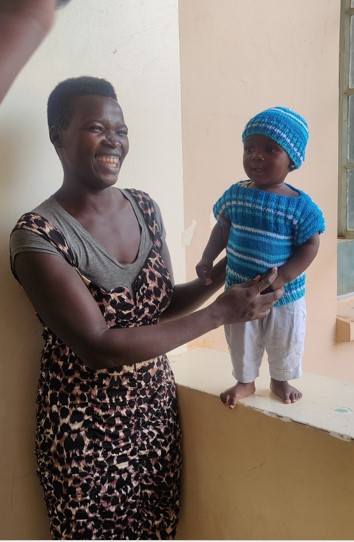
My mum’s church has a knit and natter group and they have been knitting jumpers with matching hats for us to distribute. They came in handy for packing round fragile equipment items and no spare space was wasted even inside some gum boots we took out! These were very popular and all the small children in the hospital had a set. There were a some blankets too that went to a couple of poorly older children
So, to conclude, we achieved everything we hoped we would, despite losing two working days due to circumstances beyond our control and very intermittent power supply. None of it would have been possible without Joseph and Christopher’s enthusiasm and willingness to learn new skills. They made our time in Freda Carr Hospital very enjoyable even when things weren’t quite going to plan! They took us on a trip to see the water treatment works, of which they are very proud and Christopher invited us both to share a meal in his home with his family.
On our last evening we were taken back to the Galaxy Country Club for a meal with all the hospital dignitaries and presented with gifts. Myself and Teresa were given a beautiful Ugandan dress each and Angel a Ugandan top.
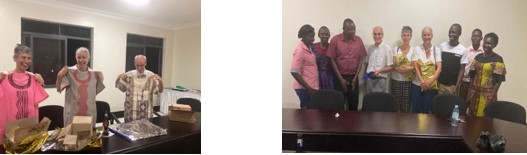
We have to finish the report by saying a huge thank you to everyone we met and who helped us. We especially want to thank both Christopher and Joseph with whom we formed a great friendship, also Stella (hospital administrator) whom we found very approachable and most supportive.
All this wouldn’t be possible without the support of Rotary Dr Bank and Mansel Thomas.
Jane & Teresa
 THE ROTARY DOCTOR BANK of GREAT BRITAIN and IRELAND.